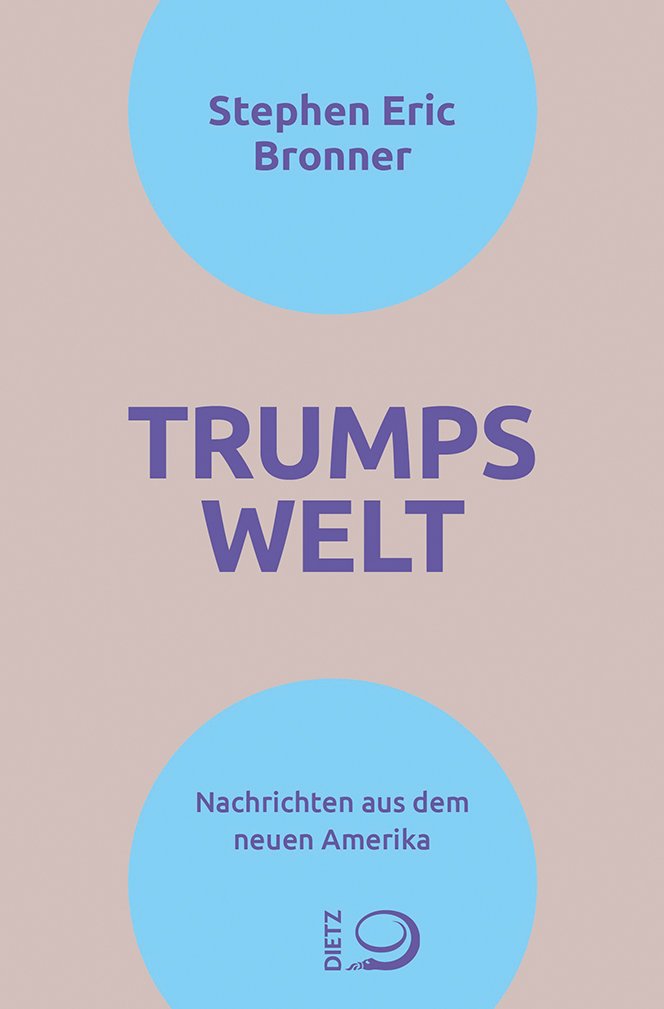
I am delighted that this little book based on my journalism is being published by Dietz Verlag whose authors reach back to Marx-Engels, Lenin, Rosa Luxemburg, and other socialist luminaries. For those of you with contacts in Austria and Germany I would appreciate it if you shared this information.
Executive Brief: What follows is the collation of views regarding European and Ukrainian security offered by activist intellectuals who took part in a symposium sponsored by the American Council for Justice and Conflict Resolution and the Ukrainian Institute for Politics.
Risks are attendant on all points raised and there is no “silver bullet” that will solve all problems. We are happy to discuss this executive brief further either in person, by zoom, or in a written form.
Dr. Ruslan Bortnik, Director of the Ukrainian Institute for Politics
Dr. Stephen Eric Bronner, President of the American Council for Justice and Conflict Resolution
Dr. Uwe Optenhögel, Vice-President of the European Foundation of Progressive Studies
Dr. Sergeii Tolstov, Institute of World Economy and International Relations of the National Academy of Sciences of Ukraine
Ms. Heather Wokusch, Director of Development for the International Forum for Understanding
I. Current Situation
American support for any institutionally organized multilateral defense of the old rules-based order can no longer be taken for granted
Europe’s “coalition of the willing” has stepped into the breach. Its $106 billion loan package offsets the economic benefits that will derive from reducing sanctions on Russia’s sale of oil.
“Ukraine fatigue” is growing and focus has shifted to other crises
Polls indicate desire for greater integration
Future criticisms of Ukraine aid as defense spending cuts into welfare programs
Europe and Ukraine find themselves in the status quo ante: Ukrainian resistance rests on Western foreign aid that has its limits leading to economic/military dependency as Russia waits
Further fragmentation of the West and new isolation of Ukraine can occur
II. What Now for Ukraine?
Recognize the urgency of peace and act on it
Avoid committing to indefinite military deterrence that will drain resources
Pursue “balanced deterrence” through greater emphasis on AI and cyber-superiority
Take a nuanced strategic approach to alliances such as BRICS
Create economic partnerships through third parties
Avoid growing influence of American corporate sectors
Mitigate possibilities forgeographic expansion of the war, military, and even nuclear escalation
III. Toward a Comprehensive Peace Agreement
Ukraine should link exit strategies to tactical military
Understand that economic investment is as much a security guarantee as usual forms of military deterrence
Include civic actors in the peace process
Begin with“breakthrough” rather than incremental issues
Refuse any concession of territory withoutmulti-lateral security regarding the protection of what remains
IV. In Response to Russian Security Interests
Ukraine should table NATO membership in exchange for explicit European security guarantees and investment
Press for “associate” status in EU
Discuss demilitarizationExpress its willingness to demilitarize, but retain police force and national militia
Accept lifting sanctions on Russia
Callfor a monitored “no-man’s land” Reject attempts to shift security guarantees from accountable traditional treaties and governmental aid to unaccountable agreements embedded in codes and corporate profits
V. Security and Democracy
Ukraine should hold elections and enforce minority rights
Includecivic actors and international stake-holders in negotiations
Avoid subordinating its policies to the military-industrial complex and being caught in “militarization trap”
Clarify difficulties of transitioning fromwar economy to durable stability
Reconstruction must target local needs as articulated by community organizations
In Charlie Chaplin’s masterpiece “The Great Dictator” (1940), there is a scene in which his character “Adenoid Hynkel,” ruler of the anti-Semitic and fascistic nation named “Tomania,” dreamily juggles a huge balloon painted as a globe – until it bursts. Should our balloon burst, and the possibility is becoming ever greater, the consequences will dwarf anything that Charlie might have imagined.
Since the start of Donald Trump’s second term in 2024, his cult of the personality picked up steam. The Kennedy Memorial Center for the Performing Arts has been renamed the Kennedy-Trump Center. The president’s name also graces the new $300 million ballroom at the White House and various other Washington buildings. In this vein, he has also called for the construction of a new “Arc de Trump,” and —significantly – plastered his moniker on a new class of Navy battleships.
On the campaign trail, Trump had promised there would be no new wars and that the United States would no longer serve as the “world’s policeman.” But we should have seen what was coming. Glimpses of the future were already apparent when the president changed the “Gulf of Mexico” into the “Gulf of America,” demanded that Denmark surrender Greenland to the United States, and called upon Canada to become our 51st state. Nor was that all. Trump renamed the Department of Defense the Department of War and, despite the cost cutting frenzy led by Elon Musk’s DOGE, he successfully pressured Congress into passing the first $1 trillion military budget in American history.
Trump’s crass public campaign for the Nobel Prize failed. An Israeli Peace Prize and another from soccer’s FIFA governing body, both hastily created for Trump, proved merely embarrassing substitutes. His attempts to coerce peace in the Russia-Ukraine War had been unsuccessful. The Gaza cease-fire was appearing increasingly fragile, and it was clear that the president had stoked international tensions with his strangely miscalculated tariff policy.
Trump claims that he has ended more than eight wars all over the globe. But the statement is thin on evidence whereas it is abundantly clear that the United States was involved in 622 air and drone strike across seven countries in 2025: Afghanistan,, Iran, Iraq, Nigeria, Somalia, Syria, Venezuela, and Yemen. The president has never been a staunch advocate of international law or human rights. To the contrary: Trump stated quite openly that he recognized no constraint on his international decision-making authority other than his own “morality” should have surprised no one.
As 2026 begins, the president has taken over Venezuela, kidnapped its noxious president, Nicolas Maduro and his wife and charged them with “narco-terrorism.” To achieve these ends, the United States launched 22 strikes that killed 110 people, murdered sailors seeking to surrender, and shelled vessels without first determining whether they were actually carrying drugs. Nor did Congress approve Trump’s act of war; it was not even briefed. The enterprise was instead prepared by Trump and a few close advisors in consultation with oil company executives; indeed, this was a war waiting for an excuse to wage it.
Why did Trump do it? The president needed something dramatic in the face of slipping poll numbers, mumblings of discontent among a few supporters, the mess surrounding the Epstein files, the anger resulting from an economic “affordability” crisis, changes in healthcare that put millions at risk, and the growing repulsion against the storm-trooper tactics of ICE against immigrants. In 2024, moreover, Trump had demanded that oil companies and the energy sector donate $1 billion to his camapign. They gave him $75 million. Coporations always expect something for their money and perhaps providing them with a profitable suruprise would make them more generous the next time around.
Given Trump’s desire to recreate a past golden age, it made sense for him to justify his Venezuelan policy by invoking the Monroe Doctrine of 1823. This seminal document of American diplomatic history warned foreign powers against interfering in the Western hemisphere, and contributed to the belief that Central and South America constituted the United States’ sphere of influence. However, Trump gave it a radical twist by declaring that the United States would “run” Venezuela until an “acceptable” sovereign is installed and for now, under his stewardship, the United States would “indefinitely” control sales of its oil and minerals on the open market.
This he calls the “Donroe” Doctrine. Justififications are of secondary importance. Insisting that the Maduro regime was an agent of “narco-terrorism,” which dominated fentanyl smuggling operations, it turnd out that Venezuela was responsible for only about 5% of the fentanyl entering the United States. Trump then changed the narrative by claiming that Maduro was the master-mind behind the cocaine plague and when that accusation fell flat, he shifted it again by condemning him as a war criminal for possessing weapons of mass destruction.
Americans cheer interventions when they begin, but quickly grow weary when the price comes due. And invading Venezuela might prove to be a high price to pay. There are strking similarities with the plans laid bare in Venezuela and the American invasion of Iraq in 2003. In both cases, there was the lure of oil, a murderous dictator to overthrow, an exaggerated “existential” threat, an arrogant conviction the citizenry of another country would welcome American “liberators” with open arms,, and disregard for the chaos that reckless regime-change would generate.
Maduro’s regime was authoritarian, brutal, corrupt and incompetent. But Trump’s actions normalize contempt for international law, rights of national self-determination, and sovereignty. Indeed, calling his overthrow an international police action agaist narco-terrorism doesn’t change that reality. Arbitrarily snatching world leaders creates widespread fear and distruction and contributes to creating a politics based on the “war of each against all’ that Thomas Hobbes feared above all else, if only because it heightens instability
As became clear in Afghanistan, Iraq, and Libya, to leave a nation without a sovereign is to condemn it to violent rivalry between paramilitary groups. Vice-President Delcy Rodriquez was installed by the Venezuelan Supreme Court as “interim” president for up to 90 days though that can be extended by legal means, and an election awaits the future. And she is in an impossible situation. Ms. Rodriquez must navigate between independence and submission. She must either stand on her own and risk regime change or serve as a shadow sovereign lacking legitimacy and power.
Trump is satisfied with what has transpired, and he feels emboldened. He is already saber-rattling while making similar charges of drug-running against Columbia, Mexico, and Cuba. Trump has also grown more bellicose in insisting that Denmark prioritize American “national security” interests, and either sell or prepare to lose its autonomous territory of Greenland. Whether discord among members of NATO will strengthen its enemies is far less important than Trump’s ability to exercise power in an unimpeded manner
Besides, these policies can change in the blink of an eye should Trump find that alternative approaches better serve his purposes. He has stated openly that his vaunted unpredictability is a tactic to keep his enemies off guard. He neglected to mention, of course, that his erratic behavior gets in the way of planning, heightens distrust, and serves as an incentive for other nations to spend more on defense. He wishes only to be able to do what he wants, when he wants, and wherever he wants. This spirit is infusing his foreign policy and contributing to a spreading existential fear of military conflict.
Nation-wide protests have rocked Iran in response to the Islamic Republic’s repression of all democratic tendencies, its incompetence in dealing with questions of infrasstructure and water, the corruption of the mullahs, and the complete collapse of the currency. These are brave people risking their lives in the streets, but Trump feels it his duty to take center stage. He has warned that he will intervene should the government wind up killing protestors. It sounds heroic, but such warnings only put protestors at greater risk because the leadership can now claim that they are traitors and agents of “The Great Satan” –and that is precisely what the Supreme Leader has done.
Trump was not thinking about the negative consequences his words might have for those Iranians fighting for freedom. But that is the point: he never thinks about others, only about himself. More likely Trump is thinking about sabotaging further negotiations on a nuclear deal, undermining a regional rival, and making himself appear once again, as with the Maduro affair, as the champion of democracy and peace. Even if the rest of the world disagrees, indeed, that is how he can view himself—and that is what counts.
*Stephen Eric Bronner is Board of Governors Distinguished Professor Emeritus of Political Science at Rutgers University and Executive Director of the “Independent Experts’ Peace Initiatives.”
Prospects for the Russian-Ukrainian conflict: causes, sanctions and possible scenarios
Introduction: The attached “white paper” is the interdisciplinary product of cosmopolitan collaboration by scholars, researchers, and political actors, who now comprise a new network: Independent Experts Peace Initiatives (IEPI). This “executive brief” summarizes the white paper—and references its appropriate sections.
Causes: Russian imperialism, NATO expansion, indifference to minority rights, historical memories, the refusal to recognize minority rights, and mutually exclusive interests culminated in the humanitarian cataclysm unleashed by Russia’s invasion of Ukraine.
Sanctions: Current sanctions have been ineffective in weakening the Russian military, devastating the economy, blocking oil and gas exports, and changing the strategic aims of the Russian Federation. They have indiscriminately targeted all citizens, fostered xenophobia, and thus, actually, strengthened the regime. Efficacious sanctions should focus on military and energy sectors of the economy, close financial loopholes, and zero-in on oligarchs.
Scenarios: We envision the following scenarios for the development of the conflict:
Russia’s military conquest of Ukrainian territory is tacitly acknowledged and the cessation of hostilities occurs without a formal peace agreement. This would most likely destabilize the region and increase the risk of further escalation. This likely scenario would mirror the partition of Cyprus.
Direct confrontation with NATO: this is a possibility, but the likelihood of this scenario coming to fruition is extremely low.
A nuclear attack is considered unlikely by most of our experts, given that the US has backed down. However, Ukrainian drone attacks and the destruction of part of Russia’s nuclear triad by Ukrainian saboteurs in June 2025 have increased the likelihood of a nuclear response from Moscow.
Russia expands the conflict: the Baltic states of Estonia, Latvia and Lithuania could be at risk. However, given the serious damage inflicted on Russia’s strategic forces recently and the prospect of a consolidated response from NATO, this scenario is unlikely to be considered realistic.
However, this does not exclude hybrid attacks, including cyberattacks, disinformation and growing geopolitical threats.
Division of spheres of influence: division of spheres of influence or implementation of the so-called “New Yalta” or “Global Compromise”, which can develop in four different directions with very different consequences.
The parties to the conflict, both Russia and Ukraine, do not show much interest in the US peace initiatives and seek to continue military action, blaming each other for the continuation of the war. In this case, events will develop in accordance with the first five scenarios.
Victims: On February 24, 2022, Russia announced the start of the so-called “special military operation” against Ukraine, which turned into the largest and most destructive military conflict in Europe since the end of World War II. Three years later over 1 million people have been killed or wounded, sexual assaults on Ukrainian women have been frequent, thousands of children have been “evacuated” to Russia, and Ukraine’s infrastructure and eco-system have been destroyed. Those rebuilding Ukraine must provide the war’s victims with free counseling and therapy, women’s centers and clinics, free burials, appropriate health care, housing and jobs, and compensation for the families.
Promoting Peace: Experts highlight key issues that participants can consider to promote negotiations and ultimately end hostilities:
Create a new collective security system that can satisfy the main players – the US, Russia, the EU and China.
Publicly acknowledge “red lines”: Russia perceives NATO expansion as a direct threat to its security.
Provide incentives for stability: The prospects for de-escalation will improve with the introduction of economic incentives.
Include “indirect participants” in the negotiations, those who can influence both sides of the conflict: not only from the West, but also from China, India and various countries of the Global South.
Call for a “freeze” of the conflict.
Discrete Prospects:
The USA is now vacillating in its commitment to defend Ukraine and, simultaneously, beginning to treat NATO and the European Union less as allies than as rivals. It is becoming increasingly unclear about how it plans to deal with them, prospects of a pending Russian offensive, and the possibility that Ukraine will not agree to a peace without guarantees that would protect its sovereignty. In lieu of American support, Europe must develop its own strategy for Ukraine and the Baltics even as it deals with internal threats from right-wing extremist movements and disagreements over how to pursue the war among its member states. It could try to build its own military arsenal, which will take time, or wait for possible regime change in the United States following the congressional elections of 2026 and the presidential elections of 2028.
Russia must decide whether the conquest of Crimea and its claims on other Ukrainian territories, which would dismember its enemy, are ends unto themselves or first steps in pursuit of more expansive imperialist aims. Divisions in the Western alliance are benefiting Russia, which might draw even closer to China, India, and North Korea (perhaps also the United States) thus altering the global balance of power. Meanwhile, Ukraine must decide whether it can survive as a neutral state (or buffer zone) between Russia and the West, and trust security guarantees from NATO, as it surrenders Crimea and parts of Donbas. Ukraine would thus retain its independence, but compromise its territorial integrity, and still require external assistance to maintain its sovereignty.
Strategic Options: Russia’s and Ukraine’s future depends on various factors: how lines of demarcation are drawn, American resolve, and the degree of European unity. Excepting the unpredictable consequences of military defeat or domestic implosion, Russia will remain a global power and, sooner or later, resume relations with Europe whereas Ukraine must find financial aid and geo-political support for rebuilding its infrastructure and defending its sovereignty. Both governments will need to “save face” and “sell” the compromises necessary for peace to their citizens. Debates over strategy will continue with respect to the possible collapse of the Western alliance, the creation of new collective security arrangements, the refashioning of NATO, the dangers posed by the BRICS alliance, and how best to strengthen Europe’s defensive capacities in response to the unpredictability of American foreign policy.
Concluding Thoughts: Flaws in the architecture of the unipolar world of the 1990s have led to the absence of instruments capable of preventing conflicts such as that taking place between Russia and Ukraine. Ending the impasse calls for serious diplomatic efforts by the combatants and their allies, but this seems a long way off. In spite of the dangers, the most available option right now calls for freezing the conflict. Risks for resuming and even escalating the war would remain, but it would buy time for agreeing on the need for new negotiations and perhaps even global compromise down the road
As things currently stand, prospects for ending the Russian-Ukrainian conflict appear slim. None of the existing options for ending the conflict will either terminate existing tensions or restore the status quo ante. The need for a new global security architecture, a new world order, is almost self-evident. However, all principal participants remain captive to outmoded ideological narratives. That is , precisely the reason why a new network capable of providing independent experts peace initiatives is necessary.
Dr. Stephen Eric Bronner, Executive Director of IEPI and Director of the International Council for Diplomacy and Dialogue
Dr. Valery Engel, Chair of the Board of Experts and President of European Council for Democracy Development
Dr. Stephen Eric Bronner is a leading political theorist, peace activist, and former Board of Governors Distinguished Professor of Political Science at Rutgers University. With over four decades of academic and diplomatic engagement, he has authored more than 20 books, advised international peace delegations, and championed human rights across conflict zones from Iraq to Ukraine.
As Director of the International Council for Diplomacy and Dialogue—USA (ICDD-USA) and co-founder of the Independent Experts Peace Initiative (IEPI), Dr. Bronner continues to bridge scholarship and activism in pursuit of global peace. In this interview with The European Times, he reflects on his journey, the motivations behind his peace efforts, and the urgent need for dialogue in addressing the war in Ukraine. What follows is a compelling discussion on realism, idealism, and the path toward ending one of Europe’s most devastating conflicts.
1.Personal Introduction & Peace Initiatives:
Robert Johnson: Could you please introduce yourself and share some of the key moments or achievements from your extensive work for peace and dialogue over the years?
Dr. Stephen Eric Bronner is a leading political theorist, peace activist, and former Board of Governors Distinguished Professor of Political Science at Rutgers University. With over four decades of academic and diplomatic engagement, he has authored more than 20 books, advised international peace delegations, and championed human rights across conflict zones from Iraq to Ukraine.
As Director of the International Council for Diplomacy and Dialogue—USA (ICDD-USA) and co-founder of the Independent Experts Peace Initiative (IEPI), Dr. Bronner continues to bridge scholarship and activism in pursuit of global peace. In this interview with The European Times, he reflects on his journey, the motivations behind his peace efforts, and the urgent need for dialogue in addressing the war in Ukraine. What follows is a compelling discussion on realism, idealism, and the path toward ending one of Europe’s most devastating conflicts.
1.Personal Introduction … Peace Initiatives:
Robert Johnson: Could you please introduce yourself and share some of the key moments or achievements from your extensive work for peace and dialogue over the years?
Dr. Stephen Eric Bronner: I grew up in a Manhattan neighborhood, Washington Heights, which was (famously) comprised almost exclusively of German-Jews who had fled the Nazis. There was hardly a family that had not lost someone in the camps. I think my contempt for authoritarianism, bigotry, imperialism, and militarism developed naturally out of my background. I was certainly prepared for City College of New York, otherwise known as the “proletarian Harvard,” which I attended from 1968-71; it was a hotspot of intellectual ferment and activism, where brilliant émigré professors and engaged students inspired my solidarity with what were courageous struggles for civil rights, outraged protestors opposing the Vietnam War, and the rights of poor people.
After my tine at City College, I attended the University of California: Berkeley, where I received my doctorate political science in 1975 following a year as a Fulbright Fellow at the Universität Tübingen, which granted me a certificate in philosophy. In short, I had interdisciplinary interests from the start. These carried over to my time at Rutgers University where I became Board of Governors Distinguished Professor of Political Science, Over 43 years there I directed 50 dissertations and, it’s fair to say, became a prolific scholar. I published 20 books, scores of articles, and my writings have been translated into well over a dozen languages; my vita is available at icdd-usa.org.
My work was inspired by a blend of cosmopolitan ideals, liberal-republican principles, and the commitment to social justice. Virtually all of it highlight the historical context with its conflicting material interests, geo-political ambitions, and ideological trends, wherein critical insights gain resonance—or not. In the aftermath of the 9/11 tragedy, and what would become a genocidal war in Iraq, I became ever more interested in civic diplomacy. As it happened, I was asked to join a peace delegation organized by Dr. Jim Jennings of Conscience International. It arrived in Baghdad about one month before the fighting began. The delegation received media coverage and a good deal of criticism upon its return and, as a consequence, I was asked to join the advisory board of the Brussels International War Crimes Tribunal. To talk about the “success” here would overstate the case Looking backward, however, our activities provided a bit of publicity for resistance in the face of lies about “weapons of mass destruction,” misguided hopes about the “welcome” that American troops would receive from the citizenry, and what was then monolithic support for President George W. Bush’s policy by politicians of both parties.
In fairly rapid succession I then became an advisor to Conscience International and then Chair of the Executive Committee for US Academics for Peace. In 2015, Mr. Eric Gozlan and I founded the International Council for Diplomacy and Dialogue and then, in 2025, it was transformed into the International Council for Diplomacy and Dialogue—USA, where I currently serve as Director. My travels as a member of various delegations took me to many countries outside Europe: Darfur, Egypt, Georgia, Guinea, Iran, Iraq, Israel, Palestine, Poland, Russia, Sudan, Syria, and – of course –Ukraine.
We met with brutal dictators trying to liberate prisoners, attempted to turn a paramilitary Janjaweed division into a sanitation corps, provide a spark of hope in Palestine, reorganize Kankan University in Guinea, speak with governmental advisory committees in Iran, create a campaign for incarcerated women in Yemen, and the – of course—there is Ukraine. In terms of honors, I am
particularly proud to have been the recipient of the “MEPEACE Award for Contributions to Peace” from the Middle East Network for Peace.
2. Motivations for Peace Projects:
Robert Johnson: What originally motivated you to focus on peace and human rights initiatives, and in particular, what drove you to take the lead in assembling an expert group to seek solutions for the Russia–Ukraine conflict?
Dr. Stephen Eric Bronner: Honors are circumstantial. In the practice of civic diplomacy, “success” is difficult to measure. The results of civic diplomacy usually appear later rather than sooner (if at all) and its small steps in the right direction depend upon a contextual clash of complex interests that is almost completely out of the activist’s control. Idealism is necessary to deal with the sour fruits of realism. Yet, idealism without realism turns into pontification whereas realism without idealism is merely an excuse for opportunism. Serious work to further the causes of peace and human rights requires both — along with the realization that it always takes a great deal of work to accomplish very little. Nevertheless, everywhere I went, brave activists — especially young people—were struggling for liberal values, republican institutions, and enlightenment ideals.
Every time I returned home, I was struck by how many Western “radicals” either take them for granted or condemn them outright for being racist, sexist, hierarchical, or Eurocentric. Liberal-republican ideals are particularly meaningful for non-Western nations languishing under brutal dictatorships and anachronistic customs and beliefs. Political activists facing corrupt and authoritarian regimes view democratic governance and socialist redistributive policies as ideals awaiting realization. Civil rights that are operative serve as the precondition for enjoying economic progress, exercising one’s identity, practicing pluralism, and –perhaps most of all—challenging the mistakes and avarice of the powerful.
The Russian-Ukraine War, is the bloodiest conflict to have taken place in Europe since the Second World War. The current discussion –or, better, obsession – with “who started it” is overshadowing what is at actually at stake, namely, that a sovereign democratic state (whatever its faults), is defending itself against destruction by an authoritarian neo-fascist regime intent on dismembering it. There is an ever more urgent need to change what is becoming crisis fatigue by those who have nothing to fear—and politicians not only don’t have all the answers, but often ask the wrong questions. Why did I and Dr. Valery Engel, President of the European Council for Democracy Development, assemble our independent experts to focus on Ukraine? Because in order to change the world it is first necessary to interpret it.
3. About ICDD-USA:
Robert Johnson: As Director of the International Council for Diplomacy and Dialogue-USA (icdd-usa.org), what are the organization’s main goals and current priorities?
Dr. Stephen Eric Bronner: ICDD-USA is a completely independent organization that engages in civic diplomacy, promotes human rights, publishes briefs and imprints, arranges and participates in international symposia, and sponsors the “Independent Experts Peace Initiatives.” I am happy to say that ICDD-USA is now officially recognized by the United Nations, the European Union, OSCE, and other non-governmental associations and institutions. But there are three aims in particular that I would like to mention: the first is that we try to highlight less the interests of this or that party to a given conflict than the usually ignored interests of civil society and those everyday people suffering the brunt of violence and devastation. We also strive to keep the public informed about events through our symposia and publications, podcasts and interviews, even as we provide balanced white papers for decision-makers that sketch scenarios that might result from any given crisis.
Grounded in the United States, ICDD-USA is a cosmopolitan organization whose executive and advisory boards are composed of intellectual-activists from all over. This reflects its belief that human rights and the liberal rule of law are not the exclusive property of the West, but universal in their salience. Among the particular concerns of ICDD-USA is the plight of minorities, the excluded, and dissidents, because it is for them – not the empowered – that freedom exists. This cosmopolitan stance translates into something important whenever the question arises in dealing with a given crisis –which side are you on? Either/or is the demand of propagandists and cheerleaders not that of people seeking dialogue and peace. The implication of the true believer is that, without unconditionally supporting one side or the other, the political actor is rendering them morally equivalent. Of course, that is a difficult claim to make when it comes to, say, Israel-Gaza or Russia-Ukraine. But those who consider any criticism of an ally as an “objective apology” for the “enemy” are disingenuous. This nothing more than the psychological manipulation of guilt masquerading as ethical commitment. How then to judge those brave citizens of Gaza protesting the authoritarian tactics of Hamas when they have suffered so much, or the Israelis protesting against the existing regime, or those who fight against Russia even as they call for elections and stand up for the minorities in Ukraine?
ICDD-USA always takes a critical stance because it always stands behind those who defend the liberal rule of law, social justice, and a secular-cosmopolitan outlook. That means specifying the mistakes made and the changes in policy that are necessary. There are no saints in politics. Those who divide the world into children of light and children of darkness breed only violence and further hatred. The truth is that there are not many wars worth fighting, politics requires compromise, and knowledge of the real conditions is necessary before leveling the charge that a “sell-out” is underway. Furthering peace calls for engaging the geo-political concerns of both sides, questioning the identification of governmental with popular interests, targeting possible compromises, and understanding that the great conflicts of our time usually don’t end with one “winner” and one “loser”—but with two “losers” The great politicians render palatable the ideological and material losses suffered by their nations and among the most important roles of organizations such as ICDD-USA is to specify the options, and the best way forward.
4. IEPI and the White Paper
Robert Johnson: You created the “Independent Experts Peace Initiative.” What inspired the project? What is its role? How does it connect with your broader vision of civic diplomacy and conflict resolution?
Dr. Stephen Eric Bronner: What inspired the creation of IEPI is quite simply the belief that an alternative was necessary to the traditional think tank along with a new form of expertise to aid decision-makers when confronting ever more complex conflicts in an ever more complex world. Dr. Valery Engel and myself were behind the attempt to create a kind of mobile tool that can assemble experts from different backgrounds and with different types of disciplinary expertise to explore the causes, the conflicting motives and interests, the possible scenarios, and the possible responses with respect to different crises. This means that the experts will change depending upon the crisis that is being investigated though, no matter what the crisis, the resulting white paper will have been produced by the same process. In each case, the project leaders will formulate a questionnaire that will be sent out to about 20-25 experts that will have been chosen according to their credentials. Detailed responses will then be collated and synthesized in the form of a document that will then be sent back to the respondents for review. After that, we will hold a conference on the white paper in order to garner further comments and ratify it in principle. That document will then be sent to contacts provided by our experts, think tanks, media people, and politicians leading to interviews, symposia, podcasts, discussions at official organizations such as the UN and the OSCE, and the like ,to publicize it. Meanwhile, a subcommittee of experts will revise the document in the light of new information and new events.
The document will serve as a kind of impartial and balanced “second opinion” that illuminates options for policymakers. Will it have an impact? The reality is that this question can’t be answered in advance. We understand that most of the decision-makers to whom we send the given white paper will toss it in the garbage can. Under the absolutely best circumstances, of course, the reader will find this the breakthrough that is necessary for a new approach to negotiating the conflict. Of course, that is unlikely, But it is possible that any given decision-maker will take a look, perhaps only at the executive brief that accompanies the white paper, and find one or two points that can be of use—and that would be enough to satisfy us. There are no guarantees in civic diplomacy: I have learned during my time as a rights and peace activist is that it always takes a huge effort to accomplish very little. It is always a mistake to promise more than one might deliver. There is a good chance that the white paper will go nowhere and, only if the organization is very lucky, will it have even a modest impact. However, all of us knew this going in: all we can do is try our best.
5. The Way Forward
Robert Johnson: What are your recommendations to advance the peace process? What are the next steps? How can the international community and civil society support these initiatives?
Dr. Stephen Eric Bronner: What steps to take in the peace process depends upon the particular scenario that presents itself. Each has its own array of responses that are explained in the white paper—and I urge your readers to take a look at the document. We know that any move toward peace has its risks and, under present circumstances, any proscription can appear utopian. Indulging in despair, however, only contributes to further paralysis. Thus, there are certain steps that IEPI would recommend:
1.The West must overcome divisions among its members concerning support for Ukraine and, in many nations, burgeoning sympathy for Russia among ever more powerful right-wing extremist parties. 2. It is necessary to rethink the current use of sanctions that have failed to weaken the Russian military, block oil and gas exports, devastate the economy or cause any significant change in strategy. They have instead made life more difficult for everyday citizens and, thereby, led them to rally around their regime. We suggest that a new sanctions-policy restrict itself to military and energy sectors of the economy as well oligarchs who are enriching themselves by manipulating the loopholes. 3. Introducing the framework for a new collective security arrangement is unavoidable would rest on Russia and NATO to relinquish any plans for expansion and Ukraine becoming a “neutral” state whose sovereignty is respected. 4. The two sides might also consider “freezing” the conflict (on the Korea model) long fixed “red lines” and the creation of a “buffer,” or “no man’s land” to demarcate territory and temper the fighting.
There is no magic formula or negotiating tactic that will resolve the crisis in the blink of an eye. Other suggestions might prove more (or less) feasible. But this EPI white paper blends idealism with realism. It enables the governments of both Russia and Ukraine to “save face,” “sell” peace without victory to their citizens, and admit the bitter truth that in this war there can be no “winner”—only losers.
*Dr. Stephen Eric Bronner is Director of the International Council for Diplomacy and Dialogue, Executive Director of the Independent Experts Peace Initiatives, and Board of Governors Distinguished Professor Emeritus of Political Science at Rutgers University.
Historical analogies are never perfect fits: 2025 is not 1938. The later date marked an attempt to impose peace on the Russian-Ukrainian War while the earlier sought to prevent war between Germany and Europe’s democracies. Still, the press conference of February 29th 2025 held by American President Donald Trump, his Vice-President, JD Vance, and Ukrainian President Volodymyr Zelinsky conjured up bitter memories. Their deal to end the Russian-Ukrainian conflict by imperiling Ukrainian sovereignty seemed much like the Munich Agreement of 1938 that sought to secure peace between Germany and Europe’s democracies by abandoning Czechoslovakia to a dismal fate.
Having withdrawn Germany from the League of Nations, ending French Occupation of the Saar, remilitarizing the Rhineland, and achieving an annexation (Anschluss) with Austria, Adolf Hitler laid claim to the Sudetenland, or parts of Czechoslovakia inhabited by ethnic Germans –and threatened war unless his demands were met. Giving in to them meant dismembering the Czech republic and its President, Eduard Beněs, refused to back down. In practical terms, however, Czech resistance depended upon support from its democratic allies, England and France.
Europe seemed on the brink of another catastrophe just twenty years after the last one ended in 1918. To avoid war, at all costs, British Prime Minister Neville Chamberlain and French Prime Minister Edouard Daladier joined the Italian fascist leader Benito Mussolini, who was ambivalent about the imperialist ambitions of his ally, and journeyed to meet with Hitler in Munich. The Führer’s behavior toward Chamberlain in particular anticipated that of Trump and Vance toward Zelensky. Hitler ranted and raved, and threw the fear of God into the leaders of Europe’s leading democracies. Nevertheless, that occurred in private while the tantrums of President Donald Trump and Vice-President JD Vance took place in pubic for all the world to see.
Not that they were embarrassed. Trump’s childish behavior has not cost him the support of his base; indeed, whatever else can be said about the president, he knows his people. Zelensky was left no choice other than accept their invitation to appear before the cameras in order to discuss the peace that merely awaited his approval. However, agreement was not enough: Trump and Vance also wanted to see the Ukrainian president grovel in public and show the appropriate” gratitude” to Trump personally for a policy initiative that would prove unfavorable to his country. This set the stage for the kind of bullying rhetoric that Trump in particular always employs.
Ukraine’s sovereignty had already been compromised; indeed, such was the price for the aid it received from the Biden administration to fight Russia’s invasion of its territory. This dependency put Zelensky at a decided disadvantage. He knew it, and the American leaders knew it, too. Then, too, Trump had long admired Russian President Vladimir Putin, and his shady real-estate dealings with Moscow are well known. By the same token, his antipathy toward Ukraine reaches back to its leaders’ refusal to falsify evidence about then Vice-President Joe Biden and his son that could prove useful in his 2020 campaign for the oval office.
“Appeasement” today has a new wrinkle. Chamberlain and Daladier meant to satisfy the imperialist cravings of an enemy, Hitler, while Trump’s policy is intended to normalize relations with Russia and favor a friend—Putin. Insisting during his presidential campaign that he could end the war “in 24 hours,” Trump is basically ready to support Putin’s claims to roughly 20% of Ukraine. As surely as Czechoslovakia in 1938, indeed, Ukraine is in danger in finding itself dismembered in 2025. However, there is a difference. Chamberlain hoped and prayed that Hitler would not make new territorial demands, and respect what remained of the Czech state, whereas Trump seems cynically unconcerned with whether Putin will refrain from further imperialist adventures.
An agreement between Trump and Putin was in the works before the press conference with Zelensky took place. It had been hammered out between the United States and Russia in Riyadh, Saudi Arabia, by American Secretary of State Marco Rubio and Russian Foreign Minister Sergei Lavrov. The talks were insular: just as Czechoslovakia and other East European states were excluded from the Munich Conference of 1938, representatives from Ukraine and the European Union were not invited in 2025. This only made sense given that the coming peace would rest on what Trump proudly termed a “very big deal.”
This deal would amount to yet another quasi-real estate “transaction” whereby the United States would receive virtually free access to Ukraine’s mineral resources in exchange for a “reconstruction investment fund” jointly managed by the two nations. The role that Trump businesses will play in this enterprise has not been made public, but rest assured, he will get his cut. In any event, Trump insists that the deal would recompense the United States with $500 billion in profits for the $130 billion in aid –not $350 billion as claimed by the American president — that had so far been given Ukraine in its fight against Russian aggression.
Appeasement today has a new twist: not only is an ally abandoned, and a dictator strengthened, but the victim of invasion is forced into paying for the invader’s gains. Repayment through the extraction of minerals would begin immediately while American investment would take place later; not exactly a formula for “joint” management. Without explicit security guarantees, belief that this deal will stem Putin’s imperialist ambitions is either naïve or a smokescreen—most likely the latter Trump has often stated that he is willing to give Putin a free hand in the region and he is clearly intent on normalizing relations with America’s former cold-war enemy.
Charitable souls can argue that Chamberlain actually recognized the danger of war and that he was buying time for England and France to begin re-arming. But that is not the case with Trump and Putin. The United States has now re-oriented its foreign policy and switched sides in this terrible war between Russia and Ukraine. Especially after having been labeled a “dictator” by Trump, it makes sense that Zelensky should have protested his treatment in front of the camera and questioned the peace agreement. Nevertheless, that his administration lacked a “Plan B” verges on the irresponsible—and the same can be said of the European Union.
Its members now find themselves in exactly the same position as the Biden Administration with regard to (unlimited) military aid for Ukraine. The EU might bribe some important nation or two, India or even China, to enter an alliance. Under any circumstances, however, Europe must now take the lead in defending Ukraine and resisting Russian imperialism. Whether that will involve increasing military aid, further boycotting and sanctions, or even creating a European army remains an open question. Turkey, France, and the United Kingdom are already talking about sending troops to Ukraine thus heightening the possibility of a broader war.
The world is still recovering from this debacle that was either purposely planned or spontaneously provoked by Trump and Vance. Zelensky kept his pride intact by publicly standing up to these authoritarian bullies. But, they will surely seek “retribution” from the Ukrainian president. Trump might end sanctions on Russia and impose them on Ukraine, or – as he stated during his diatribe – he could abandon Ukraine altogether, thus leaving it and Europe to their own devices.
No less than with Czechoslovakia in 1938, the actual subject of imperialist aggression, Ukraine in 2025 is of secondary importance in the still unfolding crisis. Still, it would be a serious mistake to assume that, should a crisis occur, President Trump will act in accord with some traditional understanding of the American “national interest.” Were that the case, he would not have chosen to confront China with high tariffs (which might reach 25% on some goods) rather than support Russia and ignore the threat posed by Putin to world peace.
Actions speak louder than words: Trump has always identified the national interest with the benefits that he or his business concerns can accrue. The political implication is that the president is not committed to any given strategy but, instead, an opportunism that masquerades as a strategy. This means that traditional alliances should no longer be taken for granted, arbitrary exercises of power are on the agenda, policy reversals can occur at a moment’s notice, and the United States can no longer be considered a reliable ally by any nation.
Appeasement in 1938 led to disaster. The lack of resolve shown by Chamberlain and Daladier led Mussolini to forge a “pact of steel” with the Nazis, emboldened Hitler in making demands on Poland, and led Stalin to rethink communist participation in the anti-fascist Popular Front of 1936. Three years later, ironically, Russia changed course entirely by signing the notorious “non-aggression” treaty with Hitler that unleashed World War II. Nevertheless, there is a key difference between then and now: Chamberlain and Daladier were afraid of Hitler and the war he could provoke, whereas Trump is not afraid of Putin.
To the contrary: America is ready to give Russia a free hand in the region, which might lead Putin to set his sights on the Baltic states. But it might also result in pressure that could force Zelensky – or a successor — to make a return visit to Washington on bended knee and accept the original deal. What comes next is uncertain. In part that is because it is no longer possible for any democratic nation to count on the United States as an ally in the defense of freedom.
*Stephen Eric Bronner is Director of the International Council for Diplomacy and Dialogue and Board of Governors Distinguished Professor Emeritus of Political Science at Rutgers University.
Trump will undoubtedly attempt to enhance his authoritarian aspirations by subordinating other branches of power to his will, inspire his base in civil society, and then, in turn, employ it to increase pressure on governmental institutions in his behalf.
And, so, it begins—again! Only this time, with new vigor, improved efficiency, and an all-encompassing agenda. Following his four-year layoff from 2020-24, in which he licked his wounds while still dominating the media, Donald Trump’s second presidency has already witnessed a blizzard of executive orders, pardons for fascists and criminals, promises to roll back the welfare state, overt threats to American democracy, and actions that endanger the well-being of the planet. This flurry of activity reflects the sobering truth that, while enough intelligent people expected him to win the election of 2024, no one believed that he would win like he did.
Trump will undoubtedly attempt to enhance his authoritarian aspirations by subordinating other branches of power to his will, inspire his base in civil society, and then, in turn, employ it to increase pressure on governmental institutions in his behalf. This might produce a transition to fascism, but to claim that fascism has taken over the United States is a drastic oversimplification. This empties the word of meaning. We are not yet living in either an authoritarian dictatorship or a “party-state”—and resistance is still possible. America’s democratic institutions and traditions are stronger than those in Italy following World War I or in the Weimar Republic. Institutional checks and balances still exist, though they are under attack, and nominal respect for our Constitution remains.
Most importantly, the military is still independent and no secret police is acting with impunity outside legal constraints. Were the state “fascist,” I would be under arrest and the venues that publish my writings would already have been shut down. Certain members of the “resistance” sometimes like to exaggerate their courage in the face of authoritarian dangers. That is insulting to those living in real fascist states who put their lives on the line daily.
“Fascist” tendencies are apparent in civil society, but it remains contested terrain: censorship, conformism, segregation, religious intolerance, and racism are rampant in many more agrarian “red states” where Trump’s base is active. In urban environments, however, myriad progressive forces challenge them and interfere with the new administration’s programs with respect to abortion, immigration, multiculturalism, and other matters. Moreover, independent civic associations still exist, other loyalties compete with what any fascist administration would demand, rights of assembly are still exercised, and debate continues in public forums. However, this is not to deny that civic freedom is imperiled—and , under Trump’s rule, the dangers seemingly grow greater every day.
Is the president a fascist? Yes. Whether he actually knows what that means is an open question, but his presentation of self and explicit political ambitions justify that view. His pathological indifference to truth, unsubstantiated claims, blatant bigotry, thoroughly corrupt inner circle, and celebration of authoritarian politics is telling. He thinks that he knows better on every issue. He rages against “enemies of the people,” threatens retribution against his opponents, and places himself above the law. Trump glories in his cult of personality and undoubtedly sees himself as Hegel’s “world spirit on a white horse.” It is his world as far as he is concerned, and the rest of us are simply allowed to live in it.
If Trump’s desired transition to some form of fascist state is successful it will have been enabled by “pragmatic” conservatives, who once foolishly thought they could act as “adults in the room” and control the upstart. The enablers of Hitler and Mussolini thought the same thing, and wound up in the same position. Soon enough the puppet was controlling the puppeteers. The president’s return to office has been marked by the self-serving use of institutional opportunities, perverse constitutional interpretations, and loopholes in the legal system to succeed in becoming the dictatorial presence he believes that he deserves to be.
Democrats still fail to appreciate the shrewdness of this New York real estate broker who closed the ultimate deal. They forget what Max Weber—among the very greatest of social scientists—knew, namely, that charisma lies in the eye of the beholder. It has nothing to do with intelligence, or kindness, or humanitarian politics. It is instead a seemingly magic connection established between the charismatic personality and those who encounter him. Of course, the magic does not magically appear. Charisma is always the product of a tumultuous context, and it is misleading to personalize what is a sociopolitical phenomenon; indeed, this misperception is precisely what Trump himself wishes to reinforce. Ultimately, the charismatic personality’s power rests on an ability to express the political thoughts and emotions of his community during any given crisis. Keeping the crisis alive thus becomes crucial, and Trump grasps that. Under his rule, no less than any other fascist, there is always a crisis and there is always publicity—whether good or bad is immaterial.
Obsessed with him, no less than ratings, established media enhanced Trump’s charisma and also provided him with billions of dollars in free publicity. In the process, they systematically underplayed former President Joseph Biden’s record. Legitimate criticisms could be made of the bungled withdrawal from Afghanistan, the president’s Gaza policy, inflation, and more. But they came while virtually ignoring Biden’s defense of democratic norms in the face of an attempted coup, his life-saving response to the Covid-19 pandemic, his bold infrastructure initiative, his protection of the welfare state and healthcare, his role in generating jobs and higher employment numbers, his reinvigoration of NATO, his defense of Ukraine, his radical environmental policies, and his heightening of America’s standing in the world. Biden’s gravitas was shaken by his disastrous showing in his debate with Trump. Poor packing helped further undermine his popularity and his presidency to the point where his substitute in the presidential race of 2024, former Vice-President Kamala Harris, couldn’t decide whether to embrace her former boss or distance herself from him.
Did this cost her the election? Perhaps. But it remains unclear what her campaign should have done instead: Poll numbers for Democrats and Republicans remained remarkably stable throughout. Not that it matters now. What does matter is that progressives still have no feasible idea for how to “reach” the most intellectually apathetic, ill-informed, prejudiced, and plain reactionary supporters of Trump who—using the colloquial phrase—“just don’t want to hear it.” The idea that the “message didn’t get out” is ridiculous: Every voter either knew or should have known what was at stake—I think they did know and each made his or her decision.
The Democrats are now faced with a stark choice: Either frighten “independents” and moderates with the haunting specter of fascism or mobilize those alienated voters who had formerly been part of their base. Democrats can’t do both at the same time. They need to make up their minds. Best for them to look in the mirror, formulate a message, stop trying to convert the collaborators, and inspire their former friends to return home.
This will require a radical stylistic change in dealing with the media and the public. With very few exceptions, such as Jon Stewart’s “The Daily Show” and John Oliver’s “Last Week Tonight,” the liberal establishment has responded to Fox News and the rest of Trump’s quasi-fascist propagandists like nerds trembling before a school-yard bully. CNN, MSNBC, National Public Radio, and the Corporation for Public Broadcasting are shifting their most critical newscasters to off hours or simply letting them go. Their hosts and commentators remain too timid, and high-minded, to deal with the vulgar, racist, and demeaning rhetoric that has traditionally been used by fascist insurgents.
Liberal media cannot again afford to provide the new president with billions in free publicity by focusing on him, and wringing their hands over his follies, while ignoring the need for unifying principles and a class agenda. This didn’t work before and it won’t work now. Trump gained votes among every meaningful demographic, and his old base remained firm. Meanwhile, identity formations in the Democratic Party turned against one another—and the wounds are still fresh. The majority of white women voted against Senator Harris, a woman of color, along with a record number of Black men, and Latinos concerned about abortion, empowerment of trans-people, and immigrants. Even worse, perhaps, too many young people stayed home. Today, the self-styled “resistance” appears lifeless, a bold programmatic alternative is lacking, and there is no resolve to move beyond identity politics, soft welfare reforms, and an ideological strategy that neither offends nor inspires.
Of course, circumstances may change. Political parties in power tend to lose votes in midterm elections, and Republicans might suffer the same fate in 2026. However, fascist parties have traditionally suffered setbacks before assuming power and there is already whispering that the midterm elections may not take place. Many are afraid that Trump (who will have served two terms) is preparing for a third term in 2028, when he will be 82 years old. We are not there yet, but much harm to democracy will surely have been done by then.
How much depends on the extent to which institutional checks and balances remain operative. Trump made 245 federal judicial appointments during his previous tenure and three to the Supreme Court. The nation’s highest court now has a conservative majority, and it already provided the president with immunity from virtually all criminal prosecution. Republicans also hold a slim majority of 219-213 in the House of Representatives and control the Senate 53-47. There should be no mistake: These are Trump’s Republicans and they are marching in lockstep. It is hard to believe that either the House, Senate, or Supreme Court will exercise checks and balances in a consistent manner.
Trump plans to “drain the swamp” and hollow out the federal government by firing tens of thousands of employees from numerous regulatory, cultural, and scientific agencies and departments. In concert with his bizarre cabinet and agency appointments to lead cabinet offices and agencies, whose only qualification is unconditional loyalty to him, this can only lead to bureaucratic anarchy. But that too is part of the authoritarian playbook. Feeding rivalries among subordinates and flunkies, like all successful dictators, the ensuing chaos can only strengthen his position. In addition, purges are being planned for the Department of Defense, the State Department, various intelligence agencies, the FBI, and the Department of Justice.
Herein is the basis for any transition to a more authoritarian state. Fascism is based on the “unification” of all political institutions—the Nazis called it “Gleichschaltung”—under the aegis of the (deified) Führer, Duce, or president. In the context of Trump’s pardons for more than 1,500 convicted insurrectionists, mostly white supremacist members of the underclass, it is not difficult to envision a private militia—a militant and violent vanguard loyal to the person of Trump—that can help bring this unification about. However, it remains incomplete without the support of elites and, to gain it, Trump has fashioned an economic agenda that benefits them. Following in the footsteps of other fascist leaders, indeed, he is selling it to his economically disadvantaged base through the use of psychological projection and his opponents supposed betrayal of the national interest.
Insisting that Democrats are catering to “special interests,” which actually comprise the popular majority, Trump has forwarded a tax cut that will disproportionally benefit the 728 billionaires who possess more wealth than half of American households combined. In the same vein, he has also called for privatizing public lands, deregulating energy production, and cutting agencies that test the safety of consumer goods and the standards of food. With regard to his base, in similar fashion, he is intent on protecting the supposedly real victims of racism (white Christian men) from further discrimination by eliminating “diversity, equality, and inclusion” programs that benefit women, the transgendered, and people of color. For good measure, casting himself as the primary victim of legal persecution, in spite of being convicted on 34 felony counts, Trump has pardoned himself and his family along with the disgraced ex-General Mike Flynn, grifters like Steve Bannon, genuine fascists like Enrique Torres of the Proud Boys, and others of this ilk. Unleashing the former insurrections would in a pinch, of course, create the disturbances that only the president can quell, thus again increasing his own power.
Foreign policy deserves its own separate discussion, but the unifying thread is already clear. It is the desire to transform a popular belief that the United States is a nation under siege into a self-fulling prophecy. It begins with sending 1,500 troops to the southern border in order to prevent an immigrant “invasion.” Trump has also provoked a tariff war with China, and another with Canada and Mexico is hanging in the balance. Outrage has already greeted his saber-rattling over Greenland and the Panama Canal, his withdrawal from the World Health Organization and the Paris climate accord, and the closing of the humanitarian aid agency U.S. Agency for International Development.
Infuriating Egypt and Jordan, two allies fearful of Islamic extremists spilling over their borders, Trump has called upon them to take in 2.3 million Gazans in order to clear out Gaza for Israel. What will happen with Russia and Ukraine is anybody’s guess, but a $177 billion aid package has already been reduced to $76 billion. For the moment, suffice it to say, that Trump’s foreign and domestic policy aims should converge in a politics that blends conflict with chaos. Our president surely hopes that this will lead citizens to rally around. him, the self-proclaimed “savior,” who always puts “America First!”
Creating such laundry lists of threats and warnings is not the stuff of great journalistic prose. However, they demonstrate the overwhelming sweep of the Trump project and the early signs, if not of fascism, then of a new order that will surely pervert American democracy. Critics need to bare their ideological teeth, unify competing lobbies, and demand a bold class agenda on par with the “New Deal” of the 1930s and “the Great Society” of the 1960s. The timidity of the president’s critics is self-defeating. The bully is still in the schoolyard, and it’s time for the Democrats to stop being scared of their own shadow. Otherwise the next four years will turn into eight—and then, if some acolyte takes on Trump’s mantle, perhaps more.
How could it have come to this? Ex-President Donald Trump has now won the presidential election of 2024 against Vice-President Kamala Harris with 51% against 48% of the popular vote and 322 as against 223 votes in the Electoral College . His Republicans -and they are his – have also taken control the Senate 52 to 48 and the House of Representatives. As for the Supreme Court, it is already dominated by conservatives, including three Trump appointees. The deck is stacked against the exercise of checks and balances. Institutional separation of powers is hanging by a thread; perhaps so is American democracy.
We were prepared for Harris to lose by a paper-thin margin. Popular wisdom had it that Harris would win the popular vote and lose the electoral college. Some of us awaited an “October surprise” in the form of a fabricated crisis, perhaps an “American Reichstag fire,” which would propel Trump into power. Especially since former Secretary of State Hillary Clinton beat Trump by 5 million votes, and President Joe Biden won by 7 million, few of us expected that the ex-president would whip Harris by 4 million votes. In the aftermath of President Joe Biden’s late withdrawal from the presidential race, which followed his dreadful debate performance against Trump, Vice-President Harris was anointed the next presidential candidate of the Democratic Party. There was no primary and no intra-party debate. Harris began the race riding a wave of enthusiasm. She garnered millions in donations during the first week, seamlessly appropriated Biden’s field operation, and crisscrossed our divided country offering a message of hope and reconciliation.
But that was virtually all she offered -other than on housing. First-generation home-buyers would receive $25,000 for a down-payment on mortgages and the Vice President promised to build 3 million more rental units and affordable homes. The other planks in her program reiterated the tried and true promises any Democrat might make: restore abortion rights, ban assault rifles, enact a minimum tax for billionaires, expand the child tax credit, and cap insulin prices at $35 for those with diabetes. She also supported legislation to stem immigration in a bill taken over from Biden that had initially received support from conservatives in the House of Representatives; it was ready for passage, until Trump expressed his displeasure, and the bill was voted down. Trump wished to keep the issue alive, and prevent Democrats from claiming credit for solving the immigration problem– he was obviously successful.
Vice President Kamala Harris is a bright, articulate, sophisticated, and center-left, woman of color with a fine quality of mind; she formerly served as a no-nonsense prosecutor and then as an undistinguished senator from California. It’s unclear whether any of her serious rivals in the Democratic Party could have done much better and it’s also unclear whether Biden could have done much worse. Harris showed empathy for those burdened by inflation and rising food prices, called for continued military aid for Ukraine and Israel, expressed support for international climate change treaties and NATO, and -above all else- highlighted the threat to democracy that Trump posed.
None of this spoke to the cultural, political, and economic crisis that has entangled the United States. Its institutions will likely ward off the threat of fascist transformation. But that is small comfort today, when the threat is grave. My generation grew up with images of Nazis implanted in our brains. The Eichmann trial was fresh in our memory and, in the 1960s, no demonstration was complete without some sign condemning “AmeriKa,” We used the term fascist indiscriminately to describe any conservative we didn’t like: Nixon, Ford, Reagan, George W. Bush, and the rest. But I don’t think any of us really believed what we were saying.
With Trump, it’s different. He really is an aspiring fascist, and he really might lead us back into what Bertolt Brecht called “the dark time.” How dark it gets depends on how much the new president-elect can get away with – and, as matters currently stand, he will get away with a lot. Bigotry, xenophobia, incoherence, megalomania, and despair over America’s future dominated the Republican agenda in Election 2024- up and down the ballot. Trump wagered that defending democracy was less important than the economic difficulties, abortion less important than immigration, science less important than faith, and pluralism less important than thoughts of an eroding culture-and 71 million Americans seemed to agree.
Is Trump a fascist? He promised his followers that he would play the dictator– at least for “one day.” He has threatened retribution against his enemies, assured everyone that his unending legal troubles would come to an end, and even begged his followers to vote in this election–since it would be the last. As Election 2024 wore on, the ex-president’s attacks on Harris and his critics became increasingly vitriolic. He and his people thundered that the Vice-President was “evil,” “vicious,” “stupid,” “retarded,” “insane,” a prostitute, and the “Anti-Christ.” The usual campaign rhetoric made way for electoral terrorism, which reached its apex at the notorious rally of October 27, 2024 in Madison Square Garden (MSG). Mimicking the event orchestrated by American Nazis in 1939, Trump’s rally unleashed the ferocious hatred of his most fanatical followers, not just for Puerto Ricans and their “garbage island,” but for just about all minorities. The bigoted invective was non-discriminatory. As for the Democratic Party, the liberal press, intellectuals and urban elites, they were labeled “the enemy within.”
Of course, this was an inversion of reality. Just as Trump called the insurrection of January 6th a “day of love,” he termed the MSG rally a “love feast.” What to believe? The choice by Trump’s zealots was unambiguous. Similar credulity was evident among those who believe that his legal troubles were the result of a conspiracy organized by “the deep state.” Evidence of his role in the insurrection has been shown multiple times on media. Countless photos also exist of the boxes full of classified documents that Trump unlawfully took from the White House and left in a bathroom of Mar-a-Lago, his estate.
Everyone should watch the excellent documentary, “64 Days” directed by Nick Quested, which explores right-wing extremist groups, such as the “Proud Boys” and “Oath Keepers, from the inside. These fanatics fueled the insurrection, and they markedly resemble the paramilitary, quasi-revolutionary, bullying, crass, violence-prone, and lumpen-proletarian Brown Shirts (SA) of the 1920s. Interestingly, the rebels interviewed in “64 Days” seem almost indifferent to politics. Other than curse immigrants, in fact, they say nothing about issues– perhaps because they have nothing to say.
They think with their gut not their brain. To them, voting for a Democrat is tantamount to treason and the system is irretrievably “broken.” Inspired by their extremism, petitions to secede from the union now exist in 12 states; 23% of the American public support this idea, and some paramilitary fanatics even talk about launching a second civil war. Such intransigence helps explain why Trump’s polling numbers never wavered despite his two impeachments, many bankruptcies, endless sex scandals, conviction on 34 criminal counts, and a horrible debate performance of his own.
Surely, only a few of Trump’s followers have even browsed the 1,000-page report, “Project 2025,” which is the Republican “plan” for the “transition.” It is the product of collaboration by 400 conservative scholars with 140 of them being members of the president’s former administration. Endorsed by over 100 conservative organizations, and with the arch-reactionary Heritage Foundation in the lead, “Project 2025” aims at “institutionalizing Trumpism.” The ex-president has deftly distanced himself from the report, but he has certainly not disavowed its recommendations -after all, his people drew them up.
“America First!” informs the undertaking. The name references America’s fascist movement of the 1930s and, while used by one of Trump’s policy institutes, it conjures up the image of isolationism in favor of right-wing causes. This fits with Trump’s stated intention of disowning international agencies and treaties that don’t suit the national interest – as defined by him. Placing “America First” abroad logically extends to privileging (real!) Americans-white Christian Americans!– at home.
“Project 2025” calls for mass deportation of “illegal” immigrants and completion of the wall on America’s Southern border with Mexico. But capitalists are more concerned with drastic cuts in welfare spending, de-regulation of markets, tax cuts favoring them, and privatization of public lands. The contradiction is palpable: Populists have ideological concerns, tend to fear big business, and support the welfare state, whereas big business is dismissive of hyper-nationalism and skeptical about investing in the public good. Empowering the executive branch of government can lead to resolution of such conflicts of interest; indeed, this top-down approach is at the heart of “corporatism,” which Mussolini initially identified with fascism.
The question is: how to empower the president? “Project 2025” gives answers. It calls for legislation to “weaponize” agencies such as the FBI, NSA, and the Department of Justice; curtail the political independence of the military; control the judiciary; constrict voting and civil rights; replace thousands of non-partisan federal civil servants with Trump loyalists; put the Federal Reserve under the president’s direct control, abolish “liberal” agencies such as the Departments of Education, Homeland Security, and the Environmental Protection Agency– and that’s just the beginning.
Election 2024 was presented by the media as a dramatic choice between an authoritarian-extremist and a liberal-establishmentarian agenda. But the drama was clearly lacking for the 1.9 million who had voted for Biden in 2020, but did not vote for Harris. Probably the combined product of centrists thinking she was too “left” on cultural issues and campus protests, leftists thinking she was too supportive of Israel and the police, and plain apathy, this decrease cost Harris dearly in the 7 swing states, all of which were carried by Trump.
Trying to straddle identity and class politics, conflicting demands between conflicting special interests, the Democrats had nothing to counter “Project 2025. Nor was the choice ever really between two candidates. It was actually always a referendum on one candidate, and one candidate alone, Donald Trump. Everywhere, on every media outlet, it had been all Trump all the time. Media played a significant role in securing Trump’s victory. After donating $100 million to Trump’s campaign, Elon Musk turned “X” into the former-president’s megaphone. Rupert Murdoch’s FOX News, whose audience dwarfs that of its cable network rivals, relentlessly distorted information and engaged in an ongoing smear campaign of Harris. Coupled with the self-interested quest for ratings by MSNBC and other liberal outlets, not to mention right-wing extremist blogs and podcasts on the Internet, Trump was provided with (literally) billions of dollars in free publicity.
Democrats watched with horror as core elements of their base defected. Unconcerned with solidarity, focused on some single issue of particular interest, 45% of Latino voters, 20% of Black voters, 39% of Asian voters, and 53% of white women sold out the first Black woman candidate for president and voted for Trump. Contrary to popular opinion, it was not the “independent” voters who cost Harris the presidency, but significant parts of groups usually associated with the Left. Decrease in voter turnout for the Democratic Party combined with defections from its mass base constituency, and rock-solid support from roughly 40% of the electorate– and this alliance made the difference.
There is no upside to this defeat. Stirring calls to “keep up the fight,” and attempts to offer a message of hope, sound hollow and desperate. Sober reflection is required instead on how to make sense of what took place, clarify our mistakes, and provide a different approach based on different assumptions. To start, we underestimated the genuine charisma of this thoroughly corrupt, ignorant, bullying, self-interested hypocrite. The jokes, the satire, and the cynical contempt for Trump blinded us to the obvious: charisma is real, but it lies in the eyes of the beholder, and it is as amoral as power.
Trump made use of a persuasive redemption narrative to reinforce it: an outsider becomes a great president against all odds in 2016, provides the citizenry with peace and prosperity, but the “deep state” denies him a second term through a “stolen” election, he is then left at the mercy of its legal apparatus, only to rise once again in 2024 – like a phoenix from the ashes– to save the country from destruction. Without him, the savior, there was no hope, and Trump’s propagandists were relentless in their predictions of doom and gloom.
Harris’ campaign was incapable of countering them. An ideal of class solidarity would have been required, and programs targeting the collective interest of workers, rather than discreet appeals to this or that special interest. The Democratic Party did not provide them – perhaps because the elites and the professional-managerial strata, which are so important to the organization, did not want them. Otherwise, it would all seem elementary: If economic issues are of primary concern to workers, and workers constitute the majority in major identity formations, then the party should provide a unifying class agenda informed by an inter-racial class ideal.
Translating that ideal into practice would initially call for specifying the shared interests of working-class elements in every identity formation without privileging any, and then formulating a program. But that is impossible while still mistakenly identifying the working class with a fading white industrial proletariat. This narrow perspective turns class into just another identity-defined interest and leaves white industrial workers battling other sectors of their own class, and existing identity formations, for what is already a shrinking pool of resources.
As matters stand right now, identity formations have devolved into special interests often wracked by factional splits. Each of these special interests has its own lobby, working for its own clients, and ready to sell out coalition partners in a heartbeat. However, realistically, it is impossible to ignore them. Translating the class ideal into policy can only occur by working inside identity groups -all the while maintaining links with the Democratic Party. The are no guarantees that activists will draw the right implications: it is easy to point fingers at those who favored the “wrong” strategy after the event. Enough acted in good faith in their attempts to ward off the fascist threat. Aside from those who actually voted for Trump, if there is blame for this electoral catastrophe, then it falls on those who abstained from voting, because they didn’t care, or self-righteously rendered their vote meaningless by casting it for marginal third-party candidates. In the Vice-President’s concession speech, she implored people to participate in politics by working with some progressive organization or other – and she was right. . There are good reasons to be afraid of what will occur the day after Trump takes office. However, resignation will only turn them into self-fulfilling prophecies. There is much necessary work to do and, I think, everyone in their heart knows it.
*Stephen Eric Bronner is Board of Governors Distinguished Professor Emeritus of Political Science and Director of the International Council for Diplomacy and Dialogue.
Once there were a few voices in the wilderness but, now, 80 countries at a Swiss summit have called for negotiations to end the two-year war between Russia and Ukraine. With Russia not in attendance, their representatives to the conference insisted that any peace plan must rest on Ukraine’s “territorial integrity.” That demand is thoroughly legitimate though it conflicts with one of Russia’s most basic war-aims. Still, there is a flickering glimmer of amid the paralysis that has defined efforts to bring both sides to the negotiating table. Russian President Vladimir Putin has stated his readiness to negotiate but his conditions are: Ukraine must first demilitarize, recognize Russian annexations, especially Crimea and territories around Kherson, reject NATO, and guarantee Russian security. Meanwhile, Ukrainian President Volodymyr Zelensky has stated that he, too is willing to negotiate, but Russia must first meet ten conditions including withdrawal of all forces from all Ukrainian territories including Crimea. The insincerity on both sides is striking: negotiations are unnecessary when the demands of each have been met in advance.
Negotiate now! The stated preconditions for talks are merely excuses to delay them There is no time to wait! Waves of Russian bombs are still blasting Ukraine’s cities to bits while Ukraine’s Kamikaze drones have struck 600 miles into Russia. Estimates are that over 450,000 Russian soldiers have been killed or wounded as against Ukraine’s 125,000 casualties at the front along with the tens of thousands more at home who are suffering from effects of the bombardment including lack of consumer staples, hospital beds, medicines, lack of electricity, water, and sanitary conditions.
All these numbers will climb: Russia’s counter-attack in the spring of 2024 has imperiled key Ukrainian cities, Belarus might open a “second front,” Putin is receiving increased aid from North Korea, endorsed its nuclear program, and increasingly threatened to employ nuclear weapons of his own. Meanwhile, Ukraine is experiencing shortages of ammunition, man-power, and its economy is eroding, while awaiting new support from its allies. The United States has signed a 10-year bilateral security agreement, offered another $50 billion in aid, and more advanced weaponry as the G-7 has appropriated $280 billion in Russian assets and imposed sanctions on those nations aiding Putin. In spite of disillusionment among sectors of the Western public, the continuation of trench war-fare, and soaring costs, the Russo-Ukrainian war is heating up rather than cooling down.
Leaders of Ukraine and Russia have both staked their reputations on military victory even though their economies are verging on collapse, and their citizens are despairing. The national interest of civil society and the national interests of governments are thus objectively in conflict. The implications for the rest of the world are clear: Ukraine is becoming ever more reliant on Western humanitarian and military aid and, in the process, compromising its sovereignty. Meanwhile, an authoritarian alliance is growing tighter between Russia, China, North Korea, Iran, and Belarus. Each of them poses geo-political threats to neighboring states and, in this regard, it is important to note that 2 out of 3 European members of NATO are now contributing their agreed-upon share (roughly 2% of GNP). Common wisdom suggests that abandoning Ukraine will tempt their imperialist ambitions. But maintaining support might produce the same result. Continuing to pour resources into this seemingly endless war can create the impression that the West has ever fewer to aid other allies such as Taiwan, South Korea, and the Baltic states. Neither continuing the present aid policy, nor radically changing it, offers any assurance of humanitarian outcomes: only successful negotiations can provide that.
Contempt for negotiation efforts by self-styled experts only turn prolonging the war into a self-fulfilling prophecy. Meanwhile, human rights activists bemoan Russian atrocities even as they endorse policies that assure their continuance. Talks cannot wait for a “tactical” nuclear strike, conditions to worsen, or the acceptance of competing war aims. That is especially the case since rough parameters for an agreement already exist:
Negotiations must include all nations directly or indirectly involved in the conflict.
Imposition of a cease-fire and troop withdrawals to the borders of March 23, 2022.
Security guarantees must be provided for both nations: Ukraine must agree not to join NATO and, in exchange, accelerate its membership in the EU. Sanctions on Russia would be lifted in accordance with its practices in de-escalating the conflict.
Five miles of “no-man’s land’ must provide a buffer between Ukraine and Russia.
Independent international agencies must monitor the peace and investigate human rights violations. For example, the UN High Commissioner on Refugees (UNHCR) will oversee plans to deal with refugees,exchange of prisoners, collection of corpses, and elimination of land-mines.
Creating an international “fund,” similar to the global climate fund, is necessary to reconstruct Ukraine.
Even speculative suggestions for peace are necessary when there is only talk of war. The humanitarian catastrophe is worsening and it is incumbent upon the global community to prioritize the material needs of everyday citizens (and soldiers) over those of governments. Not to talk about peace is to perpetuate war– pure and simple– and that is something the people of Russia and Ukraine cannot afford. Negotiate now!
O professor de Ciência Política da Universidade de Rutgers e codiretor do Conselho Internacional de Diplomacia e Diálogo esteve em Lisboa para os Mafra Dialogues.
Ao DN falou de como a guerra na Ucrânia está a ser vista nos EUA, das comparações com o conflito entre Israel e o Hamas, e dos cenários das presidenciais de novembro nos EUA.
A guerra na Ucrânia ainda é uma prioridade para os EUA face à guerra em Gaza, e tendo em conta que a China, não a Rússia, é considerada a maior ameaça para a política externa norte-americana? Quando a guerra começou, havia um apoio enorme e um entusiasmo pelos ucranianos. As pessoas estavam emocionadas com a sua resiliência e capacidade de resistência ao invasor. Agora… a verdade é que os EUA, e usando o Vietname como um exemplo, não são muito bons no que diz respeito a um apoio alargado. Especialmente para qualquer aventura militar e quando começam a perder. E claramente a situação já não é o que era. No início, parecia que seria uma questão de meses até a Ucrânia dar a volta. Foi ingénuo e excessivamente otimista. E agora, claro, há problemas imensos.
Acha que a postura do presidente Joe Biden tem sido a melhor? Acho que a política do presidente Biden tem sido muito boa. Ele garantiu um apoio alargado, um apoio que é necessário para revitalizar a NATO e para os EUA tentarem restringir e enviar uma mensagem para uma antiga superpotência que está a tentar reclamar o império que perdeu. E claro, isto solidifica os laços norte-americanos com a Europa e com alguns pequenos países da região na fronteira com a Ucrânia. Há um medo enorme, que vem de 1938, em relação à forma como os Aliados ocidentais apaziguaram Hitler… Acho que essa é uma falsa analogia. O apaziguamento é um problema quando parece que o outro lado está a ganhar e a ganhar rapidamente. E não é esse o caso aqui. Acho que talvez seja possível que o presidente Putin, se for bem-sucedido na Ucrânia, possa atacar a Moldávia e outros pequenos países frágeis, mas seria necessário gastar muitos recursos e meios humanos para pensar num ataque sério à Europa. Essa é a minha opinião.
Mas considera que a ajuda dos EUA tem sido suficiente? É algo estranho, porque apesar de Biden ter dado muita ajuda militar à Ucrânia, a ajuda é temperada, tanto na questão do que é dado – por exemplo, os EUA não deram F16 – como no facto de a ajuda estar a chegar de forma regrada. Não é como se todos os “brinquedos” militares estão a ser enviados em cinco minutos, prontos para ser usados. E claro, o presidente deixou claro que não haverá militares norte-americanos no terreno. O último ponto que gostaria de tocar é uma das críticas que faço. Acho que é importante colocar condições à ajuda que é enviada para a Ucrânia. Como foi feito em relação a Israel, quando se disse que se não der determinados passos em direção à paz, o apoio militar dos EUA pode ser diminuído.
Mas não acha que é uma situação totalmente diferente? A Ucrânia foi invadida, está a defender-se, a tentar recuperar o território, enquanto Israel é quem está a atacar Gaza para tentar desmantelar o Hamas, após o ataque terrorista do 7 de Outubro, matando nesse processo inúmeros civis… É um ponto importante. Como eu vejo, a questão não é simplesmente o Governo. É sempre um erro, da mesma forma com Israel e o Hamas, identificar os interesses da liderança com os interesses dos cidadãos. Na Ucrânia, o país está a ser completamente obliterado. É uma desgraça em termos de Direitos Humanos, tal como Gaza, onde milhões estão internamente deslocados, a infraestrutura está obliterada… Da mesma forma, o presidente Zelensky identificou os seus interesses com a vitória, pura e simples. Não acho que isso seja do interesse dos cidadãos. É outra semelhança com a situação no Médio Oriente, a obstinação de ambos os lados, de ambos os líderes. O presidente Zelensky disse que não irá negociar até todas as tropas russas terem saído do solo ucraniano. O presidente Putin disse que não vai negociar até as suas conquistas terem sido reconhecidas. O que isso basicamente significa é que não há negociações a não ser que as exigências de cada lado sejam cumpridas primeiro.
E é impossível conciliar ambas… Certo. Se as exigências de cada lado são cumpridas primeiro, então não há razão para negociar. Por isso acho que as negociações vão ter de ser impostas a partir de fora, na Ucrânia e em Gaza. Independentemente das diferenças.
O último pacote de ajuda à Ucrânia demorou mais de um ano a ser aprovado e só agora está a chegar à frente. E o que vemos é a Rússia a avançar, com os ucranianos a ter dificuldades para se defenderem. Ao atrasar essa ajuda, será que os EUA não tornaram mais difícil chegar a uma posição de negociar? Na minha opinião, e esta é uma posição que também sempre tomei em relação aos palestinianos, a questão é: será que querem minimizar as perdas ou continuar a apostar que, apesar de estarem a perder, no final vão ganhar? Será que isso faz sentido? Eu iria mais para a primeira hipótese do que para a segunda, embora seja menos dramático e menos heroico. Mas o que levantou foi uma preocupação crucial. O problema não foi com esse pacote de ajuda. O problema não foi o presidente Biden ou os democratas. O problema foram os republicanos. E também, tenho de dizer, a extrema-esquerda do Partido Democrata. De certa forma, os extremos unem-se. Para os republicanos, o isolacionismo é um tema que remonta ao presidente Wilson e à Liga das Nações, nos Anos 1920. A ideia da América Primeiro, que o ex-presidente Trump usa, era o slogan do movimento quase fascista dos Anos 1930. O movimento da América Primeiro queria que a América ficasse de fora do conflito entre fascistas e antifascistas e, nesse processo, tender a favor dos fascistas. Hoje, para os republicanos, a situação é semelhante. O partido quer que os EUA fiquem de fora da batalha, de forma a ajudar a Rússia. Se recuarmos uns anos e pensarmos nas ligações que existiam entre Putin e Trump, é claro que a posição que foi apresentada foi basicamente ordenada pelo ex-presidente, que tem muito controlo do partido nesta altura.
E no caso dos democratas? Com os democratas da extrema-esquerda é um pouco diferente. Na minha opinião, eles têm uma certa visão de um anti-imperialismo romântico. E isso envolve uma desconfiança dos EUA em questões de política externa. Alguns têm uma certa tendência de olhar para Putin com um olho na antiga União Soviética, de uma forma romântica. É completamente irrealista. Além disso, alguém me disse isto e há uma certa verdade: a esquerda americana que tem problemas em entender algo em que os EUA não são os vilões. Isso é uma posição que remonta, na realidade, à Guerra Fria e às lutas contra a Guerra no Vietname, pelas quais tive grande simpatia. A falta de confiança que é dada à NATO por esta setor da cidadania é real e tem raízes sérias no anti-imperialismo. E existe a crença básica, entre muitos, de que a NATO provocou a guerra. Por outras palavras, ao instigar, ao cortejar de forma tão forte a Ucrânia, eles atiçaram o urso. Não acho que isto faça sentido, mas muitas pessoas acreditam. Logo, há uma certa convergência entre dois grupos que, de outra forma, não têm nada a ver um com o outro. Mas isso torna-se num bloqueio e não tenho dúvida que isto será um tema nas próximas eleições.
Se os democratas recuperarem o controlo do Congresso, mesmo que Biden ganhe, esse grupo à esquerda poderá colocar barreiras a mais apoio à Ucrânia? É possível, mas é um grupo muito pequeno e muito menos poderoso do que os extremistas do Partido Republicano. Há quem diga que se Trump ganhar, haverá uma continuação da política atual. Porque será do interesse nacional não apoiar a Rússia, alinhar-se com a China, continuar a dar armas à Ucrânia. Não acho que seja verdade. Assumir que Trump vai atuar com este tipo de realpolitik rigorosa é um erro. E a sua visão de interesse nacional é sempre identificada com o seu próprio interesse. E, se isto é verdade, então vamos ver uma quebra brusca do apoio.
É isso que acha que vai acontecer se Trump ganhar? Acho que será um desastre. A minha posição sobre muitas coisas na política é: “Se alguém te diz algo, acredita. Não o descartes.” Trump ameaçou cortar entre um terço e metade de todos os funcionários federais. Também prometeu uma purga nos Serviços de Informação e no FBI, colocando as suas pessoas nos cargos, e assim enfraquecendo a separação dos poderes e reforçando o seu próprio poder. Acho que a vitória de Trump também iria capacitar os racistas, a extrema-direita, os supremacistas, os nacionalistas cristãos… Vão sentir-se encorajados. Questões como o aborto e outros assuntos que estão ligados aos direitos e liberdades civis, vão ser empurrados da mesa.
Acha que poderá ser ainda pior do que os primeiros quatro anos? O abismo não tem fim, digamos assim. E em matéria de política externa, Rússia à parte, haverá também claramente um recuar de fundos em todo o lado. A crença básica dos seus apoiantes é: “Por que é que temos que enviar este dinheiro todo para o estrangeiro, quando temos tantos problemas em casa?” Claro que os EUA não estão a chegar ao pé do presidente Zelensky e a dar-lhe 60 mil milhões… O material é fabricado nos EUA.
Grande parte do dinheiro fica na indústria de armas nos EUA, logo está basicamente a ajudar a economia norte-americana… A maioria das pessoas não sabe disso. E depois há o racismo crescente, que está a tornar-se corrosivo. As coisas que são permitidas na esfera pública… E podia ser legitimo falar assim, agir assim, nos estados mais reacionários. Mas que isto esteja a acontecer a nível federal… é muito embaraçoso.
Mas para muitos, Biden não é uma boa alternativa… Eu não percebo que se fale da questão da idade. A diferença de idades entre eles não é assim tão grande. Trump não é propriamente um jovem. E, talvez por ser mais velho, acho que devemos julgar o homem pelo que ele fez politicamente. Biden já apresentou mais projetos de lei para lidar com temas do interesse dos cidadãos americanos do que qualquer presidente desde Franklin Roosevelt ou Lyndon Johnson. Tem sido uma megamudança. Os empréstimos dos alunos que foram perdoados, a infraestrutura que foi construída, os EUA reafirmaram-se nas questões internacionais, já não somos motivo de chacota… Quando Trump estava no poder, os EUA eram uma piada constante. Acho que Biden tentou restabelecer a dignidade da Casa Branca. E é um tipo bom. Isto é de grande importância.